Trialli is the first decentralized clinical trial platform purpose-built for substance use disorder research. AI conducts clinical interviews, coordinates participants, and monitors your trial — so coordinators focus on science.
Every existing DCT platform was designed for oncology and pharmacology trials in non-stigmatized conditions. None of them understands SUD.
SUD trial dropout is the #1 cost driver. Housing instability, stigma, and variable shift work mean participants cannot keep clinic appointments — and existing platforms assume they can.
Study coordinators spend most of their time on structured check-ins, form administration, and protocol reminders — tasks that AI can handle at a fraction of the cost.
Systematic coordinator contact adds 40 days of retention. AI can scale that contact to every participant, every week — without adding headcount.
The NIDA Clinical Trials Network — 16 nodes, hundreds of SUD trials — runs on REDCap. No mobile app. No AI. No voice. Trialli is the purpose-built replacement.
The AI administers validated instruments — ISI, BAM, PROMIS, AUDIT, TLFB — via voice conversation with the participant. Structured scores are extracted automatically and stored in the EDC with confidence flags. No other platform does this.
Pre-configured SUD instruments (ASI, AUDIT, COWS, CIWA, Penn Craving Scale, Columbia Suicide Severity Rating Scale). Community-based site model for treatment centers, MAT clinics, and residential programs. Dropout-prevention design throughout.
An agentic AI system handles the full participant relationship: scheduled check-ins, missed visit detection, protocol reminders, safety screening with C-SSRS criteria, and escalation to human coordinators. Available 24/7. Scales to any trial size.
| Platform | SUD Focus | Voice AI Assessment | Patient-Facing AI | Community Site Model | Pricing |
|---|---|---|---|---|---|
| Trialli You are here | ✓ Purpose-built | ✓ Full interview | ✓ AI Coordinator | ✓ Native | Per-participant SaaS |
| Medidata Rave | ✗ | ✗ | ✗ | ✗ | $200K–$2M/study |
| Medable | ✗ | ✗ | Investigator only | ✗ | $150K+/study |
| Castor EDC | ✗ | ✗ | ✗ | ✗ | Custom |
| REDCap | ✗ | ✗ | ✗ | ✗ | Free / self-hosted |
| ObvioHealth | ✗ | ✗ | ✗ | ✗ | Custom |
Source: Competitive analysis conducted March 2026. No major DCT platform has SUD-specific positioning, instruments, or voice AI capability.
Instead of a coordinator calling each participant to manually administer the ISI or BAM, the AI conducts the interview via voice — and pushes structured, confidence-scored data directly into the EDC.
Available 24/7 on mobile. No appointment. No commute. No missed visit.
Asks ISI, BAM, or PROMIS questions conversationally. Adapts to unclear responses. Generates clarifying follow-ups.
Structured output with per-item scores, confidence levels, and full transcript. Low-confidence items flagged for coordinator review.
DataRecord stored as AI_ADMINISTERED. Full transcript linked. 21 CFR Part 11 compliant.
Every participant response is screened in parallel using Columbia Suicide Severity Rating Scale criteria. If distress or suicidality signals are detected, the assessment pauses immediately, crisis resources appear, and the coordinator receives an escalation alert. This runs on every turn, automatically.
Draft protocol, configure sites (treatment centers, MAT clinics, residential programs), assign site PIs and coordinators, invite IRB reviewers — all by email. New users get automatic account setup.
Reviewers log in, read the protocol, and approve or reject with comments. No DocuSign. No email threads. Only approved trials can activate enrollment.
Send invitations by email. Participants receive a link to the Trialli app, create an account, and see their invitation. No app store account required for web.
Participants review the full consent document, agree to terms, and sign electronically — drawn or typed signature. Consent status updates in real time for coordinators.
The AI coordinator schedules and conducts voice check-ins (ISI, BAM, PROMIS), sends reminders, detects missed visits, and escalates safety signals — all without coordinator involvement by default.
Review AI-generated assessments, manage flagged items, report adverse events, track compliance — spending time on clinical judgment, not administrative contact.
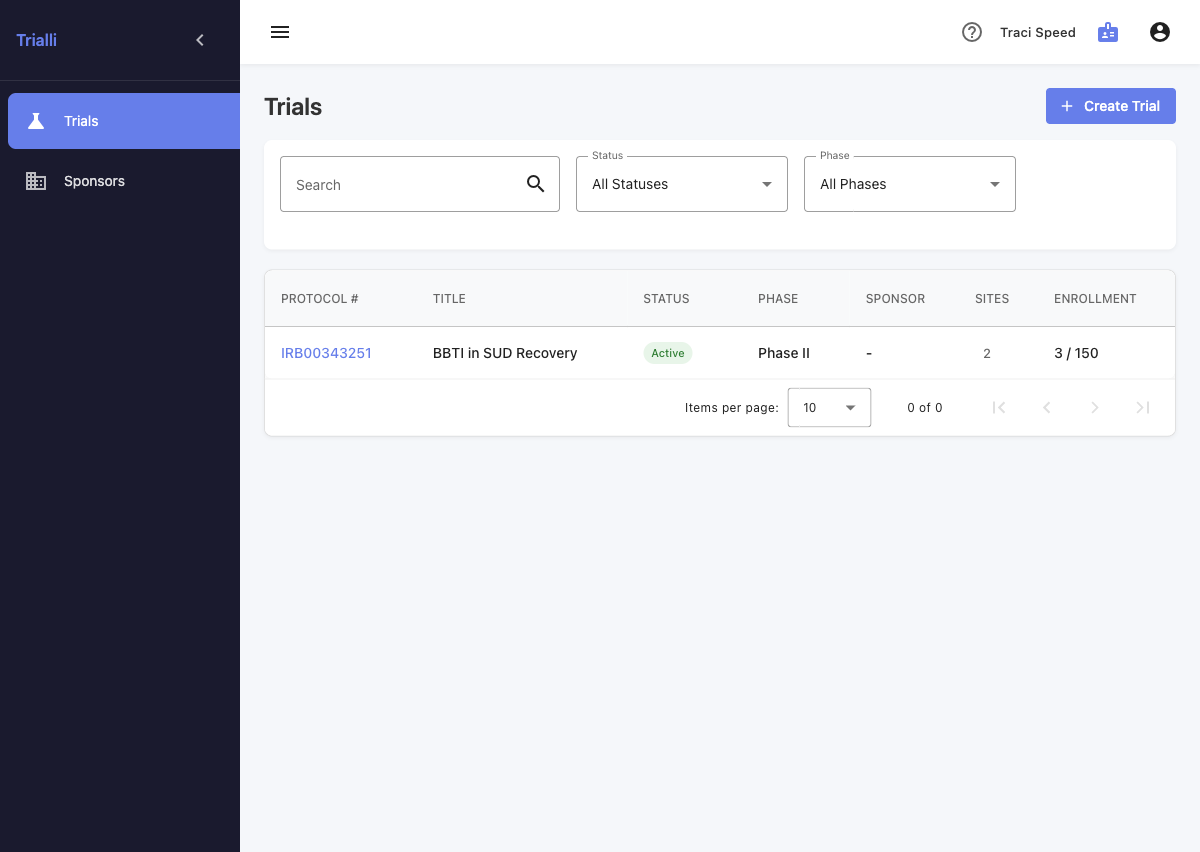
A full-featured web application for sponsor administrators and site coordinators. Manage trials, review AI-generated assessments, track compliance, report adverse events — from a single dashboard.
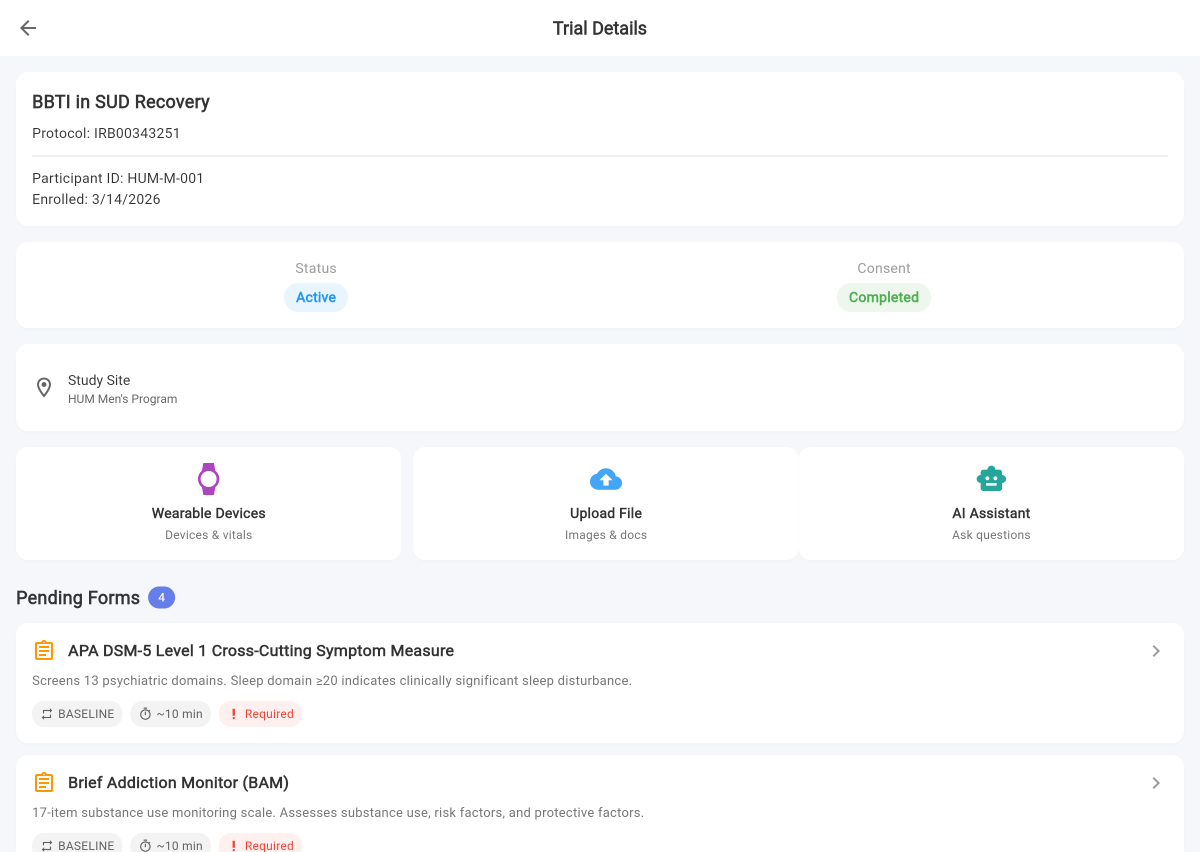
A consumer-grade mobile experience — iOS, Android, and web — designed for the realities of SUD populations: low digital literacy, variable schedules, housing instability.
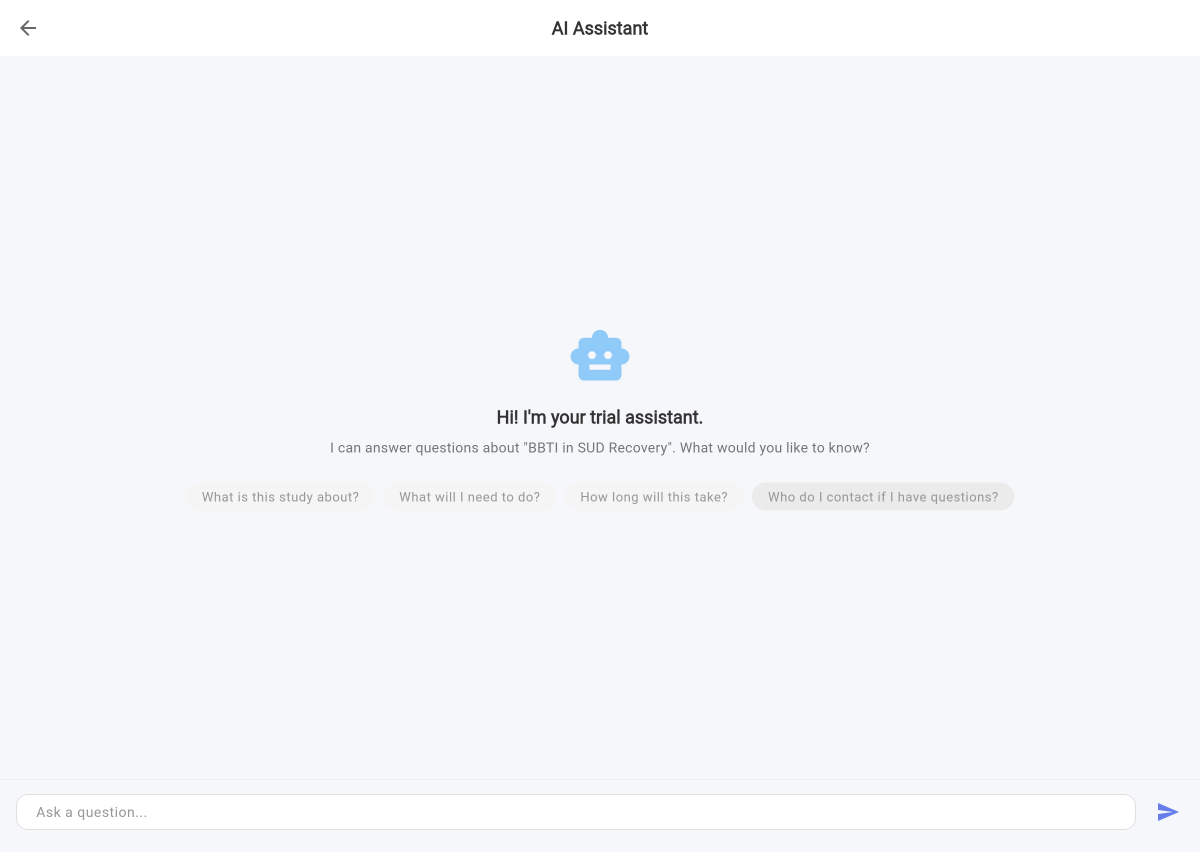
Participants get instant, accurate answers to their questions about the trial. The AI runs on a self-hosted GPU server with retrieval-augmented generation over the trial protocol and SUD literature — no participant data ever leaves your infrastructure.
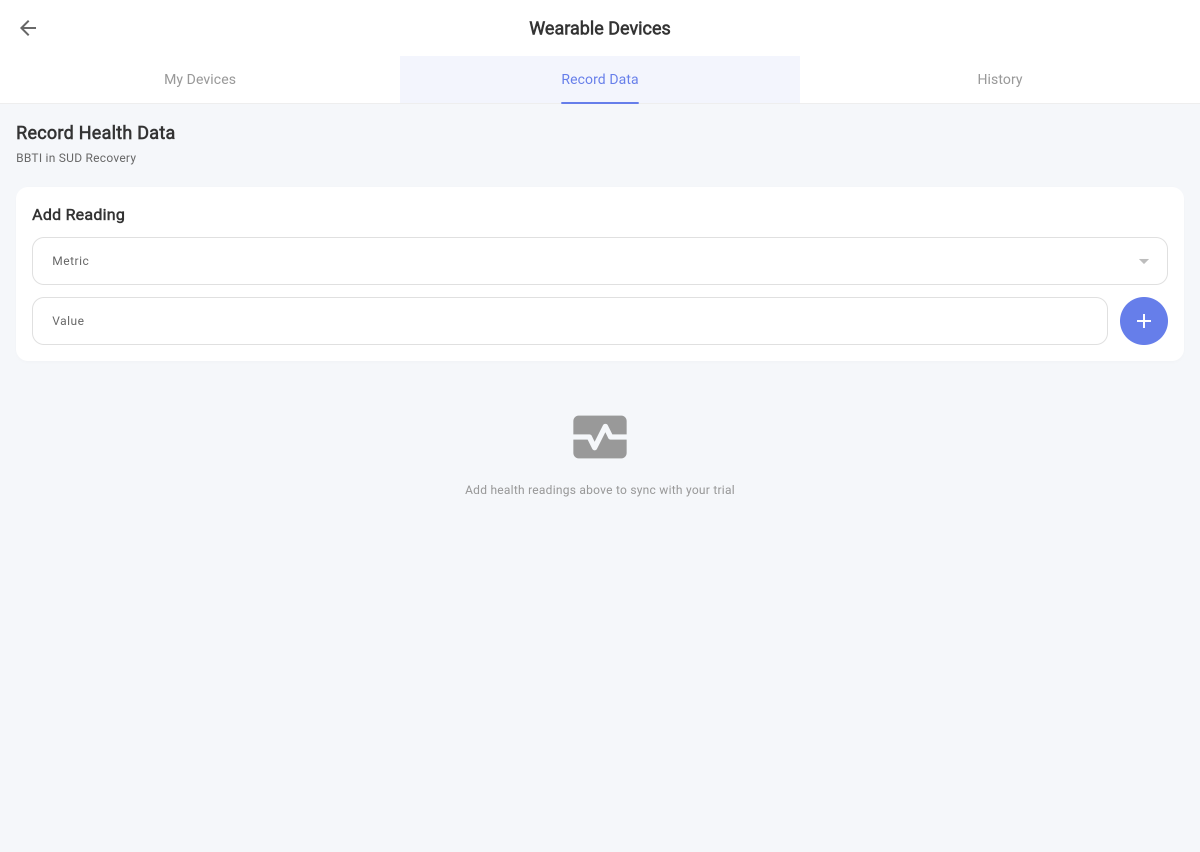
Collect continuous or episodic health data from participants using consumer wearables or manual entry. Sleep and actigraphy data map directly to BBTI and insomnia trial outcomes.
The AI administers structured clinical instruments via natural voice conversation. Participants speak their answers; AI extracts scores, detects ambiguity, asks clarifying follow-ups, and returns structured data to the EDC. Every session is transcribed, scored, and linked to the participant's audit trail.
DRAFT → PENDING → APPROVED → ACTIVE with full audit trail. Multi-site with per-site personnel, IRB approver assignment, sponsor + coordinator role hierarchy.
Participants review, agree, and sign electronically — drawn or typed signatures — right from their phone. Consent status tracked in real time for coordinators.
Structured AE reporting with severity classification and SAE escalation. Built-in C-SSRS safety screen during every AI check-in. ICH E6(R2) GCP-aligned.
iOS, Android, and web. Designed for SUD populations: simple interface, voice-first check-ins, offline form support, and crisis resources always one tap away.
A multi-agent backend that handles the participant relationship autonomously: scheduled assessments, missed visit follow-up, protocol compliance monitoring, and safety escalation routing. Human coordinators review exceptions; AI handles the routine.
Configure validated forms (rating scales, single/multi-choice, free text, numeric) with per-form scheduling, overdue tracking, and revision workflows.
Tamper-evident audit log on all critical models. 21 CFR Part 11 electronic signature support. Full trail for AI decisions, coordinator overrides, and data edits.
Claude / GPT-4o via HIPAA BAA as primary. Llama-3-Meditron-70B on-premise for air-gapped deployments. RAG-grounded on trial protocol and SUD literature.
gpt-4o-transcribe for Phase I (emulated). AWS Transcribe Medical for Phase II (real participants) — definitively HIPAA-eligible, covered under AWS BAA.
Battle-tested Python backend with role-based permissions, full audit logging, and structured output extraction using OpenAI strict JSON mode.
Standalone-component admin portal with Material Design — fast, type-safe, accessible. AOT-compiled for production.
Single codebase across platforms. Native performance. Designed for low-bandwidth and variable connectivity common in SUD participant populations.
Railway today (staging + production). AWS migration for PHI-scale with SOC 2 / HITRUST path. Self-hosted GPU for institutions requiring on-premise AI.
Trialli is built by a multidisciplinary team at the intersection of addiction medicine, clinical trial operations, and AI engineering — with NIH NIDA funding and Johns Hopkins University collaboration.
Principal Investigator & Lead Engineer
Carina Medical LLC
Placeholder — add bio and institution here.
Co-Investigator
Johns Hopkins University
Placeholder — add bio and institution here.
Role / Institution
Edit marketing/website/index.html — Team section to add members.
We're actively piloting with NIDA-funded trials and NIDA CTN-affiliated sites. Request a demo and we'll walk you through the full workflow — voice assessment, AI coordinator, and all.